
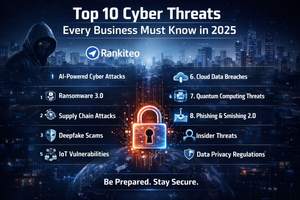
Cyber threats in 2025 are no longer a “big enterprise” problem - they’re a core business risk for organizations of every size. Cybercrime is projected to cost businesses up to $10.5 trillion annually by 2025, making it one of the largest transfers of economic value in history. Attackers are using AI, targeting small businesses, and exploiting the tools you rely on every day - email, cloud apps, suppliers, and remote access.
In this guide, you’ll learn the top 10 cyber threats every business must know in 2025, what they look like in the real world, and the practical steps you can take to reduce your risk - even if you don’t have a large in-house security team.
Why Cyber Risk Looks Different in 2025
Several major shifts have changed the threat landscape:
- AI is transforming both attacks and defense. Attackers now use AI to automate phishing, discover vulnerabilities, and evade traditional security tools, while defenders use it to detect anomalies at scale.
- Hybrid work is permanent. Employees access systems from home, co-working spaces, and mobile devices, expanding the attack surface and increasing endpoint and network risk.
- Cloud, SaaS, and APIs run your business. Misconfigurations, weak access controls, and unsecured integrations now drive many breaches.
- Supply chains are deeply interconnected. A compromise at one software or service provider can cascade across thousands of customers.
With that backdrop, let’s walk through the 10 cyber threats you cannot afford to ignore this year - and how to defend against them.
1. Ransomware and Double-Extortion Attacks
Ransomware remains one of the most damaging cyber threats to businesses, locking access to critical data and systems until a ransom is paid. In recent years, attackers have shifted to double-extortion, where they both encrypt and steal data, then threaten to leak it publicly if you don’t pay.
Recent data shows:
- About 59% of organizations were hit by ransomware over the last year.
- Global ransomware costs could reach $265 billion annually by 2031, up from $20 billion in 2021.
How ransomware hits businesses in 2025
- A user clicks a malicious attachment or link in a phishing email.
- Attackers exploit a public-facing application or remote access service to gain a foothold.
- Malware spreads across file servers, endpoints, backups, and sometimes cloud workloads.
- Critical data is encrypted; operations stop; a ransom note appears.
- Increasingly, attackers leak or threaten to leak stolen data to increase pressure.
What your business should do
- Maintain offline, immutable backups and regularly test restore procedures.
- Keep operating systems, VPNs, and public-facing apps fully patched.
- Deploy endpoint detection and response (EDR) to detect suspicious behavior early.
- Limit admin rights and use least-privilege access so malware has less room to spread.
- Create and rehearse a ransomware playbook with clear roles, contacts, and decision criteria.
2. Phishing, Social Engineering, and Business Email Compromise (BEC)
Phishing and social engineering are still the #1 way attackers gain initial access to organizations worldwide. Business email compromise (BEC) - where attackers trick staff into sending money or data - is especially costly.
Key trends:
- Small business employees face 350% more social engineering attacks than those in larger enterprises.
- Business email compromise remains a prevalent and sophisticated threat in 2025.
What these attacks look like
- Fake invoices or payment change requests that appear to come from a supplier, CEO, or CFO (BEC).
- “Urgent” messages asking staff to buy gift cards, transfer funds, or share credentials.
- AI-generated emails and messages that are linguistically perfect, personalized, and harder to spot.
- Phishing pages that clone Microsoft 365, Google Workspace, or CRM login screens to steal passwords.
What your business should do
- Implement multi-factor authentication (MFA) on email, VPN, and critical apps to reduce damage from stolen credentials.
- Provide regular, realistic phishing simulations and training for all employees, including executives.
- Use email security gateways and anti-phishing tools that analyze links, attachments, and sender behavior.
- Establish out-of-band verification processes for payment changes and sensitive requests (e.g., confirm by phone).
- Monitor email forwarding rules and impossible-travel logins for signs of account takeover.
3. Credential Theft and Account Takeover
As identity becomes the new security perimeter, credential harvesting is a dominant attacker objective. IBM’s 2025 Threat Intelligence Index reports that credential harvesting is one of the most common impacts across multiple regions and sectors.
Why this threat is growing
- Attackers use phishing, keyloggers, infostealer malware, and dark-web marketplaces to acquire passwords.
- Many organizations still reuse or share passwords and lack MFA on critical systems.
- Cloud and SaaS apps multiply the number of accounts and login points to protect.
Typical attack paths
- A user enters credentials into a phishing site.
- Malware silently harvests browser-saved passwords.
- Stolen credentials are sold, reused in credential stuffing attacks, or used to access VPNs, cloud consoles, and finance systems.
What your business should do
- Enforce strong, unique passwords and use an enterprise password manager.
- Turn on MFA everywhere feasible, including VPN, cloud admin accounts, and email.
- Monitor for impossible travel, unusual locations, or device changes in login activity.
- Regularly review and revoke stale or excessive access rights, especially for ex-employees and contractors.
4. Supply Chain and Third-Party Attacks
Supply chain attacks exploit trusted software, hardware, or service providers to compromise many customers through one breach. They’ve grown rapidly in frequency and impact.
According to recent analysis:
- Organizations hit by supply chain cyberattacks increased 2,600% since 2018.
- In 2023, more than 54 million individuals were affected, driving average losses of $82 million annually per organization in key industries.
How supply chain threats work
- Attackers compromise a software vendor and insert malicious code into updates (e.g., SolarWinds-style attacks).
- A third-party with network or API access to your environment is breached, and attackers pivot into your systems.
- Managed service providers (MSPs), payment processors, or marketing platforms are used as stepping stones.
What your business should do
- Maintain an up-to-date vendor inventory: who has access to what data and systems.
- Build security requirements into contracts: MFA, encryption, vulnerability management, incident reporting, and regular assessments.
- Limit third-party access using least privilege, segmentation, and just-in-time access.
- Monitor third-party connections and APIs for unusual behavior or data exfiltration.
- Have a plan to isolate or disable vendor integrations quickly if they are compromised.
5. Cloud, SaaS, and Container Security Risks
As businesses move more workloads to public cloud, SaaS, and containers, attackers follow. Misconfigurations and weak governance are central issues.
Key realities in 2025:
- Cloud-based systems are vulnerable to data breaches, misconfigured access controls, and unauthorized access.
- Container and microservices architectures create new attack paths if images are unpatched or misconfigured.
Typical cloud and SaaS risks
- Public S3 buckets or storage containers exposing sensitive data.
- Over-privileged cloud service accounts that can access far more than necessary.
- Poorly secured admin dashboards for CRM, marketing, HR, or billing platforms.
- Insecure container images, secrets hard-coded in code or images, and weak Kubernetes controls.
What your business should do
- Apply the cloud provider’s shared responsibility model and clarify who owns what.
- Use cloud security posture management (CSPM) tools to detect misconfigurations, exposed storage, and risky permissions.
- Enforce MFA and role-based access control for all cloud consoles and SaaS admin roles.
- Scan container images, rotate secrets, and limit network access between services.
- Centralize cloud and SaaS logs to a SIEM or monitoring platform for anomaly detection.
6. Remote Work, Endpoints, and Home Networks
Remote and hybrid work are now a permanent part of how businesses operate - and attackers know it. Remote employees often use unsecured Wi-Fi, personal devices, and home routers, which are easier to compromise than tightly controlled office networks.
Risks include:
- Endpoint compromise via phishing, drive-by downloads, or unpatched software.
- Data exfiltration from unmanaged or personal devices.
- Use of weak or shared home Wi-Fi passwords, making man-in-the-middle attacks easier.
What your business should do
- Deploy endpoint protection and EDR on all company-managed devices.
- Require VPN or secure remote access with MFA for all connections to internal systems.
- Set clear BYOD (bring-your-own-device) policies or provide secure, managed devices where possible.
- Enforce disk encryption and automatic screen lock on laptops and mobile devices.
- Train remote staff on handling sensitive data in shared spaces (e.g., co-working hubs, travel).
7. IoT, OT, and 5G-Enabled Devices
The explosion of Internet of Things (IoT) devices - cameras, sensors, smart locks, factory equipment, building systems - has massively expanded the attack surface. Many of these devices ship with weak security and rarely receive updates.
Challenges in 2025:
- 5G and edge computing increase connectivity and bandwidth, but also introduce new vulnerabilities at the edge, especially for industrial and critical infrastructure systems.
- Manufacturing, transportation, and energy sectors face heightened risk as IT and OT environments converge.
What your business should do
- Create an inventory of all IoT and OT devices connected to your network.
- Change default passwords, disable unused services, and apply updates where possible.
- Segment IoT and OT networks from corporate IT and the internet; block direct exposure of sensitive devices.
- Monitor network traffic for unusual connections from IoT devices.
- When procuring new equipment, factor in security features (update support, authentication, encryption).
8. AI-Powered Attacks and Deepfakes
In 2025, AI is not just a defensive tool; it is increasingly part of the attacker’s toolkit. Generative AI can:
- Write convincing phishing emails and scripts in any language.
- Generate malicious code and help evade traditional detections.
- Create realistic voice and video deepfakes to impersonate executives and trick staff.
Reports from major security vendors highlight AI-driven social engineering and malware-free intrusions as fast-rising threats.
Example scenarios
- A “voice of the CEO” call (created with AI) urgently asks Finance to approve a wire transfer.
- Attackers use AI to analyze your public footprint (social media, website, press) and craft tailored spear phishing.
- Malware morphs itself automatically to avoid signature-based antivirus detection.
What your business should do
- Educate staff about deepfakes and establish verification processes for voice or video-based requests, especially financial approvals.
- Use advanced behavior-based detection and AI-driven security tools that look beyond signatures.
- Limit public exposure of sensitive information about roles, vendors, and internal processes.
- Integrate AI risk into your broader fraud and cyber awareness training.
9. DDoS and Service Disruption Attacks
Distributed denial of service (DDoS) attacks flood your online services - websites, APIs, or apps - with traffic, making them unavailable to legitimate users. They can be used for extortion, distraction (while another attack unfolds), or to damage your reputation.
Key points:
- DDoS attacks can take down e-commerce sites, SaaS platforms, booking systems, and APIs, directly impacting revenue and brand trust.
- They are often launched using large botnets of compromised IoT devices and servers.
What your business should do
- Work with your hosting or cloud provider to implement DDoS protection and rate limiting.
- Build redundancy and failover into critical services (multiple regions, CDNs).
- Monitor for unusual traffic spikes and have runbooks for traffic filtering and incident communication.
- Coordinate with your ISP and upstream providers as part of your DDoS response plan.
10. Insider Threats and Human Error
Not all threats come from anonymous hackers. Insider threats - whether malicious or accidental - remain a major driver of breaches.
Recent data indicates:
- 48% of organizations report insider attacks becoming more frequent.
- Many incidents still stem from misdirected emails, misconfigurations, or accidental data exposure.
Types of insider risk
- Disgruntled employees stealing data before resigning.
- Well-meaning staff misconfiguring cloud storage or sharing files publicly.
- Contractors with lingering access to systems long after projects end.
What your business should do
- Apply least-privilege and just-in-time access: users get only the access they truly need, for as long as they need it.
- Automate joiner-mover-leaver processes to remove access promptly when roles change or people leave.
- Use data loss prevention (DLP) and behavioral analytics to flag unusual data movement.
- Foster a culture where employees feel safe reporting mistakes early, before they become full incidents.
How to Prioritize Your 2025 Cybersecurity Roadmap
You don’t need to solve everything at once. Focus first on controls that reduce multiple threats at the same time.
Start with these high-impact basics
- Identity and Access Management (IAM)
- Enforce MFA on email, VPN, and critical apps.
- Review and right-size permissions regularly.
- Patch and Configuration Management
- Patch internet-facing systems, VPNs, and remote access tools promptly.
- Fix misconfigured cloud storage and access controls.
- Backups and Recovery
- Maintain offline, immutable backups of critical systems.
- Test restoration regularly to ensure you can recover from ransomware.
- Awareness and Training
- Run ongoing phishing and social engineering training.
- Include deepfakes, AI-powered scams, and remote-work hygiene.
- Monitoring and Incident Response
- Centralize logs for users, endpoints, cloud, and network.
- Document and rehearse an incident response plan covering ransomware, BEC, and data breaches.
FAQs: Cyber Threats Businesses Are Asking About in 2025
1. Are small businesses really targets, or just collateral damage?
Small and mid-sized businesses are prime targets, not collateral damage. Over 60% of SMBs report being targets of cyberattacks, and small business employees receive significantly higher rates of malicious emails and social engineering attempts than those at large enterprises. Attackers know smaller organizations often have weaker defenses.
2. What is the most common initial way attackers get in?
Across multiple threat reports, the top initial access vectors remain:
- Phishing and spear phishing attachments.
- Exploitation of public-facing applications and remote services.
If you improve email security, patch external systems, and harden remote access, you dramatically reduce overall risk.
3. Is AI more of a cybersecurity opportunity or a threat?
It is both. AI helps defenders detect anomalies faster, correlate massive data sets, and automate responses. At the same time, attackers use AI to craft convincing phishing, discover vulnerabilities more efficiently, and build malware that evades signatures. The businesses that win are those that adopt AI-powered defenses while updating policies and training to address AI-powered attacks.
4. Which industries are being targeted the most?
Recent threat intelligence shows:
- Manufacturing has been the most attacked industry for several years, reflecting its role in global supply chains and reliance on legacy systems.
- Finance and insurance, professional and business services, and transportation are also heavily targeted due to the value of data and potential for disruption.
However, every sector - including retail, healthcare, education, and professional services - faces material risk.
5. How do cyber incidents impact reputation and growth?
Beyond direct financial loss, cyber incidents:
- Erode customer trust and brand credibility.
- Cause downtime that kills conversions, bookings, and online revenue.
- Damage search visibility when sites are compromised or blacklisted.
- Divert leadership focus and budgets away from growth initiatives toward incident recovery.
For any business investing in marketing and digital growth, cyber resilience is now core to protecting that investment.
Building a Cyber-Resilient Business in 2025 and Beyond
The cyber threats facing businesses in 2025 - from ransomware and BEC to supply chain attacks and AI-powered scams - are serious, but they are also manageable with the right approach. The most resilient organizations:
- Treat cybersecurity as a board-level business risk, not just an IT problem.
- Invest in identity-first security, strong access controls, and a Zero-Trust mindset.
- Continuously monitor, test, and improve their defenses, instead of relying on one-time projects.
- Build a culture where every employee understands their role in protecting data and systems.
Start by shoring up the fundamentals: MFA, backups, patching, employee awareness, and clear incident response. Then, layer on more advanced controls for cloud, supply chain, and AI-driven threats as your maturity grows.
By taking a proactive, risk-based approach today, your business can stay ahead of the top cyber threats of 2025 - and build the secure foundation you need for long-term digital growth.