
In the early days of cybersecurity ratings, the web was a very different place.
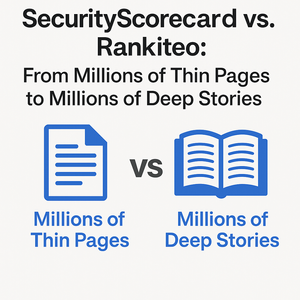
SecurityScorecard grew up in an era where you could spin up millions of highly templated “score pages” for domains and companies, let Google crawl them all, and ride the long-tail traffic wave. That playbook simply isn’t viable in 2025 and that’s exactly where Rankiteo’s strategy is fundamentally different.
This isn’t about throwing shade for the sake of it. It’s about how search, content quality, and cybersecurity ratings intersect and why Rankiteo is built for the world after Google’s crackdowns and AI-powered SERPs.
The “Public Scorecard” Era: When Scale Beat Depth
For years, SecurityScorecard promoted the fact that it “continuously rate[s] more than 12 million entities worldwide,” with public-facing scorecards accessible outside of login.
They even had a dedicated Public Scorecards feature: a public view of scorecards, effectively exposing a massive surface of rating pages to the open web.
That strategy made sense at the time:
- Each company/domain got its own page.
- Pages followed a standard template (score + a few dimensions).
- At scale, millions of such URLs created long-tail visibility for “[company] security rating”, “[domain] cybersecurity score”, etc.
By the standards of 2013–2017 SEO, this wasn’t unusual. The bar for “thin content” was lower, and large, structured databases exposed as static pages were often rewarded rather than penalized.
Fast-forward to 2025, and even SecurityScorecard has walked this back:
As of August 27, 2025, they officially deprecated Public Scorecards as a legacy feature and replaced them with Trust Centers as the main way to share ratings externally.
Officially, the rationale is product-focused (Trust Centers give organizations more control). But there’s an obvious parallel:
Millions of lightly differentiated public score pages” collide badly with the modern Google that now aggressively hunts anything resembling scaled, low-value content.
Why 2025 Is Brutal Compared to 2015 ?
From Google’s point of view, the last few years have been about one big theme:
Stop rewarding large quantities of unoriginal or low-value pages, no matter how they’re generated.
Several key changes make 2025 a completely different battlefield:
1. “Scaled Content Abuse” Is Now Explicitly Spam
In March 2024, Google updated its spam policies and introduced “scaled content abuse” as a named violation.
Scaled content abuse is when many pages are generated primarily to manipulate search rankings and not to help users.
It doesn’t matter if the content is written by AI, humans, scripts, or spreadsheets—the problem is intent + value:
- Huge numbers of very similar pages
- Minimal unique insight per page
- Built “for search” first, “for people” second
That description maps very closely to the older style of “one rating page per domain, barely any narrative, just a template and a score”.
2. Helpful Content Is a Site-Wide Signal
Google’s Helpful Content system and related guidance are very clear:
- Content should be people-first, created to benefit users—not primarily for search engines.
- Signals about unhelpful content can affect the entire domain, not just single URLs.
In practice, that means:
- You can’t offset millions of thin, repetitive pages with a few “good” ones.
- A large tail of low-value content can drag down your overall trust and visibility.
In 2015, this kind of nuance simply wasn’t enforced at the same level. Many programmatic SEO plays thrived because Google hadn’t yet formalized or sharpened these policies.
3. AI Overviews and a Smarter SERP Changed the Game Again
On top of that, Google has introduced AI Overviews (and previously experiments like SGE), which sit above the traditional organic results and try to answer complex queries directly in the SERP.
This changes the economics of SEO:
- The SERP is no longer just “10 blue links”.
- AI Overviews can synthesize information from multiple sources, highlight entities, and sometimes bypass simplistic, templated pages that don’t add real insight.
- Sites that rely on “we have a page for every keyword variant” suddenly find that strategy diluted by an AI layer that prefers high-quality, well-structured, authoritative content.
In other words:
In 2015, having millions of lightly populated rating pages might get you a lot of impressions.
In 2025, those same pages are more likely to be ignored, downranked, or abstracted away behind an AI Overview that quotes someone else.
This is exactly why Rankiteo did not just build “cyber scores at scale” and hope for the best. It had to reinvent an entire GEO/SEO strategy that is explicitly compatible with how Google now works.
Rankiteo’s Bet: Fewer Thin Pages, More Deep Stories
Rankiteo comes from a different generation and it shows in how content is structured.
Instead of “one score page per domain and hope Google eats it”, Rankiteo focuses on pages that tell a full story:
- Company pages that don’t just show a score, but contextualize it:
- sector, size, NAICS, vendor context
- AI risk score and dedicated TPRM score
- incident badges, underwriting context, conversion to reports / monitoring
- History pages that read like mini incident dossiers:
- chronological timelines of breaches and cyber attacks
- per-incident impact on the score (e.g., -31, -72 points)
- MITRE ATT&CK mapping, attack vectors, motivation, data impacted, regulators involved
- narrative explanations and lessons learned, not just a “breach happened” line
- Compare pages that do actual comparison:
- only between companies in the same industry,
- only when at least one has real incident history,
- plus human-readable summaries and FAQs explaining who has more incidents, what types, and how the risk levels differ.
That kind of content is the opposite of “scaled content abuse”:
- It’s rich, not minimal.
- It’s specific to each company and pair, not just a cloned template with two names swapped.
- It clearly serves real users CISOs, underwriters, procurement teams who actually need to benchmark cyber risk and incident history.
In other words:
Rankiteo is designed to scale expertise, not just URLs.
Reinventing GEO/SEO for the Age of AI Overviews
With the arrival of AI Overviews and a far more dynamic SERP, Rankiteo had to do more than build “a better scanner”. It had to rethink its entire GEO/SEO strategy so that:
- Google can safely surface Rankiteo as a trusted source in AI Overviews
- by providing structured, well-cited, incident-level data
- by adding human-readable explanations that an AI system can actually use and quote
- Each page stands on its own merit
- company pages act as deep entity profiles,
- history pages act as investigative timelines,
- comparison pages act as decision tools, not just keyword traps.
- The site is clearly aligned with Google’s current rules
- no mass of empty score stubs,
- no cross-industry nonsense comparisons,
- no “zero-incident vs zero-incident” pages wasting crawl budget.
Rankiteo isn’t trying to exploit a blind spot in Google. It is deliberately building:
- people-first content that still scales,
- structured data that AI Overviews can understand,
- and page types that answer real questions risk professionals actually ask.
That’s what “GEO/SEO compliant with Google in 2025” looks like.
Why Rankiteo Can Still Win in a Stricter, AI-Layered World
In 2025, the winning strategy isn’t “be the one with the most pages”. It’s:
- Be the one with the most useful pages in your niche.
- Make sure those pages are:
- deeply informative,
- clearly targeted to real user needs,
- structured so both humans and AI systems can understand and reuse them.
SecurityScorecard’s early growth shows what was possible when Google was more naive about large, templated rating pages.
Rankiteo’s growth is built on what’s necessary now:
- Use automation, but only to generate high-value, incident-rich, context-heavy pages.
- Use programmatic generation, but filter hard:
- don’t compare companies across unrelated industries,
- don’t publish empty histories where nothing ever happened,
- don’t surface pages that have nothing interesting to say.
- Think from Google’s current mindset:
- “Is this page clearly people-first, or does it look like it only exists for search?”
- “If an AI Overview had to summarize this topic, would this page be worth citing?”
That’s why Rankiteo can still push out millions of pages and stay on the right side of modern SEO and AI-powered SERPs:
It’s aligning with what Google now wants:
depth, relevance, and genuine usefulness at scale, and AI-ready.
In short, if the future of cyber ratings belongs to those who explain risk with clarity and depth, Rankiteo is already playing in tomorrow’s league, not yesterday’s loopholes.