
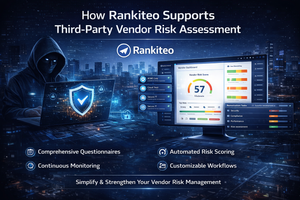
In today's complex digital landscape, third-party vendor risk assessment has become a critical priority for organizations managing extensive vendor ecosystems. With cyber threats evolving rapidly and regulations like GDPR and HIPAA demanding stricter oversight, businesses need reliable tools to evaluate vendor security postures, quantify risks, and ensure compliance. Rankiteo, a leading cybersecurity scoring platform, empowers teams with AI-driven insights that go beyond traditional questionnaires, delivering real-time visibility into vendor risk management (VRM) to help insurers, financial institutions, and enterprises mitigate exposures effectively.
Rankiteo's platform analyzes billions of signals weekly, including attack surface vulnerabilities, historical incidents, and compliance gaps, enabling precise third-party risk scoring that supports informed decision-making and portfolio resilience. This post explores how Rankiteo streamlines vendor risk assessment, drawing on its proven capabilities trusted by global enterprises and recognized by G2 with a 4.8/5 rating for ease of use.
Why Third-Party Vendor Risk Assessment Matters in 2026
Organizations increasingly rely on third-party vendors for critical operations, but this introduces significant risks. Recent data shows that 40% of vendor contracts are finalized without proper security assessments, leaving companies vulnerable to breaches and regulatory fines. High-profile incidents, such as supply chain attacks, underscore the need for robust TPRM - third-party risk management - strategies that address cybersecurity, financial stability, and operational resilience.
Vendor risk isn't static; it shifts with emerging threats like ransomware and cloud misconfigurations. Traditional methods, like periodic questionnaires, often fail to provide real-time insights, resulting in siloed efforts and overlooked gaps. Rankiteo addresses this by offering continuous monitoring and automated scoring, helping users tier vendors by actual risk levels - critical for those handling sensitive data or embedded in networks.
Key challenges in vendor risk assessment include:
- Incomplete visibility: Manual inventories miss fourth-party risks.
- Resource strain: Assessing 500+ vendors manually is inefficient.
- Compliance pressures: Frameworks like NIST, ISO 27001, and SOC 2 require ongoing proof of due diligence.
By integrating AI-driven analytics, Rankiteo transforms these challenges into actionable intelligence, reducing breach risks and enhancing operational efficiency.
Rankiteo's Core Features for Vendor Risk Management
Rankiteo stands out as a unified scoring and risk platform, purpose-built for TPRM. Unlike competitors relying on self-reported data, it scans external signals - email security, DNS health, open ports, SSL configurations, and prevalent vulnerabilities - to generate objective cyber risk scores. Trusted by industries like banking, insurance, healthcare, and aerospace, it has scored over 160,000 organizations worldwide.
Automated Vendor Detection and Inventory Building
Maintaining an accurate vendor inventory is the foundation of effective VRM. Rankiteo's automatic vendor detection feature identifies and categorizes technologies and vendors in your ecosystem seamlessly, ensuring comprehensive coverage without manual input. This aligns with best practices from experts, who recommend real-time updates to track third-party relationships dynamically.
For instance, the platform detects embedded vendors across your supply chain, flagging potential single points of failure early. Users report quick implementation, with no lengthy onboarding, making it ideal for scaling assessments across hundreds of vendors.
AI-Powered Risk Scoring and Benchmarking
At the heart of Rankiteo is its advanced cybersecurity risk scoring, built on 200+ academic models for unparalleled accuracy. It evaluates vendors across key categories:
- Cybersecurity posture: Technical controls, attack surface, and incident history.
- Financial stability: Liquidity ratios and revenue trends.
- Compliance: Alignment with HIPAA, GDPR, and sector benchmarks.
- Operational efficiency: Uptime, defect rates, and resilience metrics.
Scores provide sector-wide benchmarking, enabling users to quantify aggregate exposures. For insurers and underwriters, this means setting accurate premiums and reducing claims uncertainty - features highlighted in independent comparisons as game-changing. G2 reviewers praise its clear, standardized scoring for objective vendor comparisons, replacing inconsistent spreadsheets.
| Risk Category | Rankiteo Assessment Factors | Benefits for TPRM |
|---|---|---|
| Cybersecurity | Open ports, vulnerabilities, email/DNS security | Proactive breach prevention |
| Financial | Stability metrics, breach cost calculators | Portfolio resilience |
| Compliance | NIST/ISO gaps, regulatory tracking | Audit-ready reporting |
| Operational | Attack surface monitoring, uptime | Continuous visibility |
This table illustrates how Rankiteo outperforms questionnaire-based tools by delivering validated, external data.
Continuous Monitoring and Threat Intelligence
Static assessments are obsolete in 2026. Rankiteo offers ongoing monitoring with automated alerts for anomalies, such as new vulnerabilities or ransomware exposures. Its supply chain risk mapping and data exposure detection provide a unified view of first- and third-party risks from a single dashboard.
Recent enhancements include vendor-specific risk intelligence dashboards and integration with MSSPs, ensuring adaptability to client environments with minimal false positives. This supports risk-based prioritization, focusing efforts on high-risk vendors like those managing sensitive data.
Step-by-Step: Implementing Vendor Risk Assessment with Rankiteo
Rankiteo simplifies the vendor risk assessment process into an efficient workflow, outperforming top-ranking posts that emphasize manual steps. Here's how to leverage it effectively:
- Build Your Vendor Inventory: Use automatic detection to catalog all third-parties, including fourth-parties, with details on access levels and data handling.
- Conduct Initial Scans: Input domains or APIs for instant scoring - receive insights on 50+ risk factors within minutes.
- Tier and Prioritize: Apply FAIR-inspired quantitative analysis to rank vendors by loss exposure, criticality, and financial impact.
- Monitor and Remediate: Set up real-time alerts and remediation plans, tracking KPIs like incident response times.
- Report and Comply: Generate audit-ready reports for stakeholders, demonstrating due diligence.
This process reduces assessment time from weeks to hours, as noted by users in finance and insurance. For high-risk vendors, combine Rankiteo scores with tailored checklists incorporating NIST or SOC 2 standards.
Pro Tip: Integrate with Rankiteo's homepage for enterprise-grade dashboards, streamlining cross-functional oversight via a dedicated VRM committee.
Real-World Applications and Success Stories
Rankiteo excels in regulated sectors. Insurers use it to map vendor ecosystems, uncovering compliance gaps and benchmarking against peers - key for premium accuracy. In banking and healthcare, it identifies ransomware exposures and data leaks, preventing costly incidents.
G2 reviews highlight tangible wins: One team streamlined vendor evaluations, achieving faster decisions and better collaboration. Another in higher education praised its vulnerability assessments for securing critical infrastructure. Independent rankings position Rankiteo as a leader for organizations with 500+ vendors, outpacing traditional solutions in automation and accuracy.
Compared to competitors like SecurityScorecard or BitSight, Rankiteo's AI analyzes diverse signals for deeper insights, with recent modules for supply chain mapping and breach calculators.
Overcoming Common Vendor Risk Assessment Pitfalls
Many organizations struggle with these issues:
- Overreliance on questionnaires: Unverifiable responses lead to blind spots - Rankiteo validates externally.
- Ignoring fourth-parties: Automatic detection closes this gap.
- Inconsistent tiering: Objective scores ensure risk-based focus.
- Lack of real-time data: Continuous monitoring flags changes instantly.
By addressing these, Rankiteo builds scalable VRM programs, aligning with 2026 trends like AI automation and unified risk views.
Visit Rankiteo today to scan your first vendor and experience the difference in actionable, real-time risk intelligence.
Emerging Trends and Future-Proofing with Rankiteo
Vendor risk management in 2026 emphasizes AI for real-time assessments, stricter regulations, and cloud security. Rankiteo's roadmap - including enhanced threat integration and enterprise quantification - positions it ahead, supporting zero-trust models and BAA enforcement.
Forums like Reddit and Quora echo user needs: "How do I monitor 100+ vendors without burning out my team?" Rankiteo answers with automation, earning praise for ease and ROI.
Elevate your third-party vendor risk assessment with Rankiteo: Quantify risks precisely, monitor continuously, and secure your ecosystem. Start your free scan at rankiteo.com to build resilience today - your vendors, and your business, depend on it.